
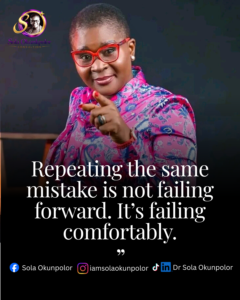
In my work with leaders and professionals, I’ve seen people romanticize failure in a way that actually keeps them stuck. They repeat the same mistakes, stay in the same patterns, and then label it “failing forward” to feel better about not changing.
That’s not growth.
That’s repetition with better storytelling.
Failure Is Not Automatically Valuable
We’ve created a culture where failure is almost celebrated by default. But failure, on its own, teaches nothing.
Reflection teaches.
Ownership teaches.
Correction teaches.
Without those, failure is just wasted time and energy.
So yes, many fail.
But the real issue is not that few fail forward.
The real issue is that many people don’t do the work required to turn failure into forward movement.
The Discipline Behind “Failing Forward”
Failing forward is not a mindset. It is a discipline.
It requires you to ask hard questions:
- What exactly went wrong?
- What part of this was my responsibility?
- What must I do differently, specifically, next time?
Most people skip this stage because it is uncomfortable. It’s easier to say “I learned something” than to actually change something.
When Failure Becomes a Trap
Here is the controversial part:
Sometimes, the problem is not that you need to “fail forward.”
Sometimes, the problem is that you need to stop failing at the same thing.
If you keep launching and failing without improving your thinking, your strategy, or your execution, you’re not building resilience.
You’re building a pattern.
And patterns, if left unchecked, become identity.
A Better Standard
Instead of glorifying failure, I challenge my clients to aim for something higher:
Don’t just fail forward.
Fail with precision.
Make fewer mistakes.
Make smarter decisions.
Shorten the distance between error and correction.
Because growth is not proven by how often you fall.
It is proven by how quickly and clearly you adjust.
The Real Question
So yes, many fail. But the question is not whether you fail forward.
The real question is:
Are you actually improving… or are you just becoming more comfortable with failing?
Because those are two very different paths, and only one leads anywhere meaningful.
Dr. Sola Okunkpolor
A Strategy & Systems Expert for Education, Business & Institutional Growth.