
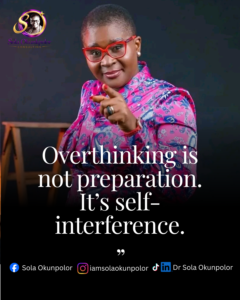
There was a time I would rehearse a simple introduction ten times.
Not because I lacked capacity.
Not because I had nothing to say.
But because I was trying to control how I would be perceived.
I wanted to sound perfect.
I wanted to impress.
I wanted every line to land.
Ironically, the more I rehearsed, the more anxious I became.
That was my first real encounter with a trap many people don’t even realize they are in.
The Real Problem Is Not Fear
Most people assume they struggle with speaking because they are afraid.
But that is not always true.
Many people are not struggling because they cannot speak.
They are struggling because they are thinking too much while trying to speak.
Think about what goes on in your mind in those moments:
You are thinking about your grammar.
You are thinking about your outfit.
You are watching the audience’s facial expressions.
You are wondering who is judging you.
You are anticipating mistakes before you even begin.
At that point, it is no longer communication.
It becomes something else entirely.
When Communication Turns Into Self-Surveillance
Overthinking creates a dangerous shift.
You move from expressing a message to monitoring yourself.
You begin to observe your every move, your every word, your every reaction in real time.
This is self-surveillance.
And self-surveillance kills presence.
It disconnects you from your message.
It creates imaginary criticism that has not even happened.
It pushes you out of authenticity and into performance mode.
And the truth is simple:
Forced performance always feels unnatural, both to you and to your audience.
Why Perfection Is the Wrong Goal
One of the biggest misconceptions about communication is the belief that perfection is the goal.
It is not.
Clarity is more powerful than perfection.
Audiences are not sitting there waiting to score you on flawless delivery.
They are listening for something much simpler and much deeper.
They are asking:
- Does this feel real?
- Does this feel honest?
- Does this feel human?
People connect to sincerity.
They connect to truth that feels unfiltered and grounded.
Perfection may impress for a moment.
But authenticity is what creates lasting connection.
What Happens When You Stop Performing
Something powerful happens the moment you shift from performing to expressing.
Your body relaxes.
Your thoughts begin to align.
Your message becomes clearer.
Your presence becomes stronger.
You stop trying to control every outcome.
You start focusing on what actually matters.
And people can feel that difference.
You Are Not Afraid. You Are Overloaded.
Let’s call it what it really is.
You are not afraid.
You are overloaded.
Too many thoughts.
Too many filters.
Too much self-editing happening in real time.
The solution is not to “try harder” or “be more confident.”
The solution is to reduce the noise.
The One Question That Changes Everything
If you want to communicate better, anchor yourself in one simple question:
What is the message I need to communicate clearly?
That question brings you back to center.
It removes the distractions.
It silences the noise.
It redirects your focus from yourself to your message.
And that is where effective communication begins.
Final Thoughts
You do not need to be flawless.
You need to be present.
You do not need to impress.
You need to communicate.
And you certainly do not need to sound like anyone else.
You need to sound like yourself.
That is where real confidence begins.
Let’s Hear From You
Have you ever experienced a moment where overthinking held you back more than fear?
Share your experience.
Dr. Sola Okunkpolor
A Strategy & Systems Expert for Education, Business & Institutional Growth.