
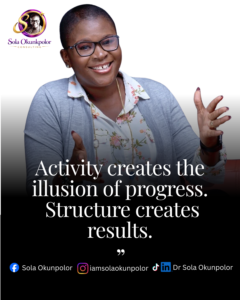
One of the most common leadership traps is confusing activity with effectiveness.
Many organizations are extremely busy.
Meetings fill the calendar.
Messages never stop.
Reports are constantly being prepared.
Everyone looks occupied.
Yet, results remain inconsistent. Decisions still stall.
The same problems keep resurfacing.
And leadership feels permanently stretched.
This is not uncommon.
And it is not accidental.
Activity Creates the Illusion of Progress
Busy organizations often feel productive because movement is visible.
People are:
- Responding to emails
- Attending meetings
- Fixing issues
- Following up endlessly
- Reacting to urgent matters.
But activity answers the question:
“Are we doing things?”
Effectiveness answers a different question:
“Are the right things being done — consistently, with impact?”
An organization can be constantly in motion and still be standing still.
What This Looks Like in Real Life. In schools, it often shows up as:
- Teachers working long hours but struggling with consistency.
- Leadership constantly intervening in classroom or administrative issues
- Frequent meetings without clear follow-through
- Policies that exist but are not embedded in daily practice.
In institutions and businesses, it appears as:
- Senior leaders approving everything
- Teams waiting instead of acting
- Duplicated effort across departments
- Performance issues addressed repeatedly without lasting change
The common thread is not laziness or incompetence. It is structural misalignment.
Why Busy Systems Burn Out Good Leaders
When systems are weak, people compensate with effort.
Leaders step in to “help”.
They become the connector, fixer, reminder, and decision-maker.
Over time, the organization learns to depend on presence instead of process.
This creates:
- Exhaustion at the top
- Confusion below
- Fragility across the system
The busier the organization becomes, the more dependent it is on individuals rather than structure.
Healthy Organizations Feel Different
Healthy organizations are not necessarily quiet — but they are clear.
In effective systems:
- Roles are understood
- Decisions move without constant escalation
- Routines replace repeated explanations
- Accountability is built into the process
- Leaders focus on direction, not daily rescue
Work still happens. But it happens with less friction and more predictability.
The Shift Leaders Must Make
The most powerful leadership question is not:
“Why is everyone so busy?”
It is: “What is this system forcing people to work around?”
Because when the structure is right:
- Effort reduces
- Outcomes improve
- People feel supported instead of stretched
- Leadership regains space to think
Busyness is not a badge of honor.
It is often a signal that something deeper needs attention.
Dr Sola Okunkpolor
A Strategy & Systems Expert for Education, Business & Institutional Growth.
I can fix myself into your peice above. But how practicable it will be in an organisation like school is what we really need.