
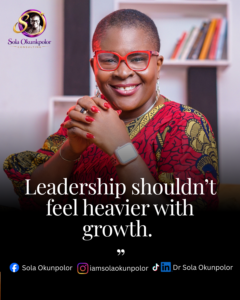
Many organizations celebrate growth when numbers go up.
●More staff.
●More clients.
●More departments.
●More activity.
But quietly, behind the scenes, leadership becomes heavier.
Decision-making slows down.
Everything requires the leader’s approval.
Simple issues escalate into daily fires.
And what was once exciting growth begins to feel like strain.
This is one of the most misunderstood phases of organizational development.
Growth Does Not Automatically Create Clarity!
In fact, growth often exposes what was never properly built.
You see, many organizations expand in size but lose clarity because:
●Roles were never clearly defined
●Processes grew informally instead of intentionally
●Systems were designed for “where we were,” not “where we are now”
●Leadership remained operational instead of becoming strategic.
So while the organization grows outwardly, internally it becomes more fragile.
Why Leadership Starts to Feel Exhausting.
When leaders feel overwhelmed, the default assumption is often personal:
“I need to work harder.”
“I need to be more present.”
“Maybe I’m not managing well enough.”
But in most cases, stress is not a personal failure.
It is a structural signal.
It is the system telling you:
decision pathways are unclear
authority is centralized unnecessarily
accountability is weak or informal
the organization has outgrown its operating model
No amount of personal resilience can compensate for structural gaps.
The Difference Between Busy Growth and Sustainable Growth.
Busy growth multiplies effort.
Sustainable growth multiplies capacity.
Organizations that scale well do not rely on heroic leadership.
They rely on:
- Clear structures
- Defined decision rights
- Documented processes
- Leadership layers that function independently
- Systems that reduce friction instead of creating it.
In such environments, leadership becomes lighter — not heavier. Because the system carries the work.
What Systems Thinking Changes
A systems thinker does not ask, “Who is failing?”
They ask, “What structure is producing this outcome?”
Instead of managing symptoms, systems thinking focuses on:
how work flows
how decisions are made
how responsibility is distributed
how accountability is enforced
how growth is supported without bottlenecks
This shift is what allows organizations to grow without burning out their leaders.
The Real Question Leaders Must Ask
The question is not:
“Why am I so tired?”
The real question is:
“What in this system requires too much of me?”
Because when systems are right:
leadership becomes strategic
execution becomes consistent
growth becomes stable
and clarity replaces exhaustion
Growth should expand impact — not drain the people leading it.
Dr Sola Okunkpolor
A Strategy & Systems Expert for Education, Business & Institutional Growth.